

Each week, Patrick shares his perspective on the forces shaping global markets, the Jamaican economy, and what investors should be paying attention to. In this inaugural edition, he explores why discipline may be an investor’s greatest advantage in a market that appears increasingly comfortable with risk.
INTRODUCTION
Every weekday morning, somewhere in Kingston, Mandeville, or Montego Bay, a hardworking Jamaican checks the balance on a savings account. The number has barely moved.
It is a familiar ritual, repeated millions of times across the island each year. And it sits at the heart of a question I think we should be asking more directly: what, exactly, is the Jamaican savings industry doing for the people it serves?
This note examines that question across four dimensions. First, the simple arithmetic of what Jamaican savers earn against what inflation costs them. Second, how Jamaican saver outcomes compare with those in peer small open economies. Third, how the pattern has held across five years of widely varying policy environments. Fourth, what binds the current outcome in place — and what could, in principle, change it.
1. THE ARITHMETIC
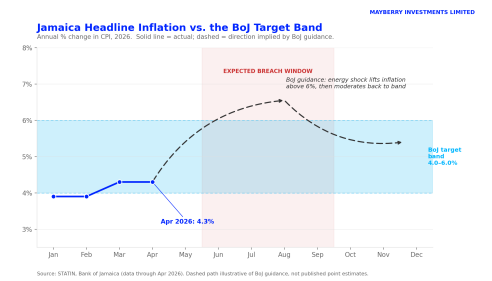
The numbers are not flattering. Conventional savings products in Jamaica today pay, on average, less than one percent. Inflation at April 2026 was 4.3 percent, with the Bank of Jamaica forecasting it will drift higher through mid-2026 toward the upper end of its 4 to 6 percent target band. A household with J$500,000 set aside for an emergency, a child’s education, or a parent’s retirement earned roughly J$2,500 before tax over the past year. Over that same year, that same J$500,000 lost approximately J$22,500 in purchasing power.

These figures are not extreme assumptions chosen to make a rhetorical point. They are conservative. At the midpoint of the BOJ’s 4 to 6 percent target band, the inflation loss rises to J$25,000. At the upper end, J$30,000. The arithmetic of conventional saving in Jamaica produces a real loss in every plausible scenario where inflation stays within target.
For the Jamaican saver, the meaningful question is not what nominal rate appears on the savings statement. It is whether the real return on patient capital is positive or negative. In 2026, on conventional savings products, it is materially negative.
2. THE REGIONAL COMPARISON
The instinctive response to these numbers is to point at the central bank. The Bank of Jamaica’s policy rate sits today at 5.5 percent. If savings products pay below 1 percent, surely the difference reflects funding economics that institutions have little choice about.
But the regional comparison undermines that argument.

The Central Bank of Trinidad and Tobago has held its policy repo rate at 3.5 percent. Trinidadian commercial banks pay an average of 1.5 percent on household deposits. The Central Bank of Barbados regulates a minimum deposit rate, and Barbadian banks pay roughly 2.0 percent in practice. Both jurisdictions have policy rates meaningfully below Jamaica’s, and both deliver savers materially more than Jamaican banks do.
The United States provides a developed-market reference point. The Federal Reserve target rate sits at approximately 3.5 to 3.75 percent. The FDIC national average savings rate is 0.38 percent. The US gap looks comparable to Jamaica’s in basic savings, but US savers have something Jamaican savers do not: easily accessible alternatives. High-yield savings accounts in the United States routinely pay 4 percent or more. Money market funds, broker-dealer cash management accounts, and certificates of deposit are available to retail investors with modest minimums and without advisor relationships. The Jamaican saver has no such alternatives at retail scale.
The picture is uncomfortable. Jamaica has the highest policy rate of the four comparison economies. It pays its savers the least. Among small open economies in the Caribbean, the Jamaican saver is the worst-treated.
3. THE HISTORICAL RECORD
If the regional comparison frames Jamaica’s saver outcome relative to its neighbours, the historical record demonstrates that the outcome is not cyclical. It is structural.

Through five years of widely varying policy environments — from emergency low rates in 2020 to multi-decade highs in 2023, to the moderation now underway — the savings yield paid by Jamaican commercial banks has remained roughly constant at around half a percent. The Bank of Jamaica’s policy rate has swung from 0.5 percent to 7 percent and back to 5.5 percent. Inflation has swung from 5 percent to over 10 percent and back. The saver’s experience has barely changed.
The clearest piece of evidence on this point came from the Bank of Jamaica itself. In December 2022, then-Governor Richard Byles addressed Parliament’s Standing Finance Committee. He said this. Between October 2021 and October 2022, the BOJ’s policy rate rose by 650 basis points. Over that same period, the weighted average deposit rate paid by Jamaican deposit-taking institutions rose by only 49 basis points. A pass-through rate, in effect, of less than 8 percent.
When the BOJ Governor publicly observes that his policy actions are not being transmitted to savers, that is not a personal opinion. It is an institutional finding. Three and a half years have passed since that speech. The structural feature it described remains.
4. THE BINDING CONSTRAINT
The structural reasons for the gap are well understood inside the industry. Funding mix, the regulatory framework around demand deposits, the cost of branch infrastructure, and the limited competitive pressure from non-conventional alternatives are all part of the picture. Each piece, considered on its own, has a defensible rationale.
But if I had to name the binding constraint, it is this. The Jamaican savings industry has been built around capturing the value created by saver patience, not redistributing it. The infrastructure exists to serve the institution first. The customer experience exists to retain the deposit. The information disclosure exists to obscure the real return. The aggregate outcome is that the Jamaican saver — the most patient and least demanding customer in the financial services value chain — receives the smallest share of the value she creates.
This is not a moral argument. It is an economic one. Jamaican commercial banks operate on net interest margins of approximately 4 to 5 percent, among the higher levels in regional comparison. These are profitable institutions. The funding cost they save by paying savers half a percent rather than three percent flows to the same place that higher loan rates flow: institutional profitability.
That ought to be uncomfortable. It is uncomfortable to me.
5. ALTERNATIVE VIEWS CONSIDERED
This note’s central thesis is contested by serious people in Jamaican financial services. Three counter-arguments deserve direct engagement.
The default risk premium argument.
Wide deposit-rate-to-policy-rate spreads in emerging markets reflect default risk that does not exist in developed-market banks. This argument has merit at the level of sovereign debt and unsecured corporate credit, where Jamaica’s history justifies a real risk premium. It is less compelling for retail deposits. Customer deposits at Jamaica’s commercial banks are supervised by the Financial Services Commission and insured by the Jamaica Deposit Insurance Corporation. The default-risk premium does not explain why the same bank, supervised by the same regulator, will pay three percent on a one-year fixed deposit and half a percent on a savings account with the same customer’s money. The gap is not about risk. It is about the architecture of saver choice.
The cost of branch infrastructure argument.
Jamaica’s branch infrastructure and operating cost base genuinely support a wider spread than developed markets allow. This argument was defensible twenty years ago. With mobile banking, white-label platforms, and fintech alternatives now widely available, the cost-to-serve a Jamaican retail saver has collapsed. The spread has not collapsed with it. If branch cost were the binding constraint, the digital banks and fintech alternatives that have emerged in the past decade would have closed the gap. They have not — because the institutional architecture has not yet been built to challenge it at retail scale.
The efficient market argument.
The market is efficient. If savers wanted higher yields, they would choose certificates of deposit or money market alternatives. They have made an informed choice for liquidity over yield. This argument requires the saver to know what alternatives exist and to have access to them. In Jamaica, both conditions are weaker than the argument assumes. Savings statements do not show real returns after inflation. Alternative products either do not exist at the retail scale that would be widely accessed, or are gated by advisor relationships and minimum-balance thresholds that exclude most retail customers. The efficient-market response presumes information and access that Jamaican savers, on average, do not have.
None of these arguments is unreasonable. None of them, individually or collectively, accounts for the persistence of a 5-percentage-point gap between Jamaica’s policy rate and what Jamaican savers actually receive.
6. WHAT THE WEEK AHEAD BRINGS
The Bank of Jamaica’s monetary policy committee meets later this month. Consensus expects no change in the policy rate. The next inflation print will give us a sharper read on whether the recent uptick is temporary or persistent. JSE volumes are likely to remain light as schools wind down for summer. None of this, on its own, will move the needle on the saver question.
But the bigger conversation — the one running quietly underneath all the rate decisions and inflation prints — is overdue for an honest re-examination.
7. WHAT COMES NEXT
For most of the last decade, the implicit deal offered to Jamaican savers has been: keep your money in a conventional product, earn very little, but sleep at night. That bargain made sense when the alternatives were limited, opaque, or required levels of financial sophistication most savers did not have. It made sense when the only people with institutional-quality access to professional wealth management were the already wealthy.
It makes considerably less sense in 2026.
The technology that allows daily liquidity, professional portfolio management, and transparent reporting at a fraction of historical cost is now widely available. The regulatory framework, while still requiring real care, accommodates products that did not exist a decade ago. Jamaican savers themselves are more financially literate and more digitally fluent than at any point in our history.
What is missing is not the saver, the technology, or the policy environment. What is missing is a willingness, on the part of the institutions that benefit from the current arrangement, to deliver something materially better.
I have spent the last several months thinking carefully about what better would look like. The honest answer is that Jamaican savers do not need a better version of what they have. They need a different relationship between their money and the people managing it. There will be more to say in the weeks ahead.
The small number on a Jamaican saver’s statement is not the natural order of things. It is the product of choices made by an industry that, for too long, has profited from the conversation being quiet.
The first step toward changing that is the math no savings statement shows you. Take what your savings earned last year. Subtract the inflation rate. That number — your real return — is the conversation we should all be having.
It is about to get louder. I know which side I want to be on.
Patrick Bataille Chief Executive Officer,
Mayberry Investments Limited
METHODOLOGY NOTE
The “average Jamaican savings yield” used throughout this note is based on weighted average deposit data published by the Bank of Jamaica and is best characterised as “below one percent” rather than as a single point estimate. The Bank of Jamaica publishes separate series for demand deposits, savings deposits, and time deposits. The savings deposit rate has consistently tracked well below the term deposit rate published by the same institutions, which is the conventional “deposit rate” reported in international datasets. Where this note uses “savings yield” for Jamaica or comparison economies, the intent is to capture what a typical retail saver in a basic, instant-access savings account actually receives, not the more attractive rates available on locked-in term deposits.
Regional comparisons should be read with the caveat that “deposit interest rate” data published by the World Bank, IMF, and most international data aggregators typically reflects one-year term deposit rates rather than instant-access savings rates. Where the savings deposit rate is meaningfully lower than the term deposit rate, as is the case in Jamaica, this can understate the saver problem in international comparison. The cross-country comparison in this note attempts to use savings deposit rates where available and term deposit rates with appropriate notation otherwise.
The Dominican Republic was considered as a comparison economy but ultimately omitted from the regional chart because the publicly available “deposit interest rate” series for the Dominican Republic (6.03 percent at February 2026) reflects term deposits and is not directly comparable to the savings deposit rates used for Jamaica, Trinidad and Tobago, Barbados, and the United States.
SOURCES
Bank of Jamaica. Monetary Policy Press Releases, February 2026 and May 2026; Quarterly Monetary Policy Reports, 2020 through 2026; Speech of Governor Richard Byles to the Standing Finance Committee of Parliament, December 2022; Commercial Banks Interest Rates statistical publications.
Statistical Institute of Jamaica. Consumer Price Index releases, April 2026 and prior.
Central Bank of Trinidad and Tobago. Monetary Policy Announcement, March 2026; commercial bank deposit rate data.
Central Bank of Barbados. Monetary policy publications and minimum required deposit rate framework.
Federal Reserve System. Federal funds rate target.
Federal Deposit Insurance Corporation. National Rates and Rate Caps, May 2026.
World Bank Global Financial Development Database. Bank net interest margin and cost-to-income ratio for Jamaica.
This commentary represents the personal views of Patrick Bataille and is provided for informational and educational purposes only. It does not constitute investment advice, an offer to sell, or a solicitation of an offer to buy any security or financial product. Past performance is not indicative of future results. Mayberry Investments Limited is regulated by the Financial Services Commission of Jamaica.