


INTRODUCTION
Each week, Patrick shares his perspective on the forces shaping global markets, the Jamaican economy, and what investors should be paying attention to. In this inaugural edition, he explores why discipline may be an investor’s greatest advantage in a market that appears increasingly comfortable with risk.
Drawing on a cricket analogy familiar to many Jamaicans, he reminds us that success often comes from knowing which opportunities to leave alone. A thoughtful read on patience, perspective, and long-term investing.
The finest innings I ever watched at Sabina Park was built not on the balls the batsman hit, but on the ones he left alone. Delivery after delivery angled across off stump, inviting the drive; ball after ball he shouldered arms and let it pass through to the keeper. The crowd grew restless. He was not being timid — he was waiting for the ball that was his to play, and refusing, with real discipline, to be drawn into the dozen that were not. I have come to think that is the whole game, at the crease and in markets alike.
This week the bowling is relentless, and most of it should be left alone. Consider the scene. The S&P 500 closed Friday at 7,580, its ninth consecutive weekly gain — the longest such streak since 2023 — with the Dow above 51,000 for the first time and the VIX, Wall Street’s fear gauge, dozing at about 15. All of this with an unfinished war in the Middle East, an American inflation reading on Thursday that was the hottest in nearly three years, and a global tariff regime the courts struck down again only weeks ago. Markets, in short, are serenely pricing a happy ending. That serenity is the first delivery I would leave.
The reason for the calm sits in a barrel of oil. Brent, which spiked above $115 in March as the Strait of Hormuz seized up, has fallen to roughly $91 — down some 15% in May alone — on reports of a tentative 60-day ceasefire and a reopening of the strait. It is a genuine relief; it is not yet a deal. As of the weekend the agreement was unsigned, the President’s “final determination” still pending, and there were missile exchanges as recently as last week. The market is betting on a swift, clean end. History counsels humility. Even if the guns fall silent, Hormuz does not reopen at the flick of a switch — mines must be cleared, damaged infrastructure repaired, shut-in production coaxed back. The risk is asymmetric: most of the good news is already in the price, while a relapse would re-rate energy violently. A fear gauge at 15, against a war not yet ended, is exactly the kind of tempting full delivery that gets edged to slip.
The ball genuinely worth playing arrives Friday, with the U.S. employment report — bracketed by the ISM surveys on Tuesday, euro-area inflation on Wednesday, and the European Central Bank’s decision on Thursday. April’s payrolls rose 115,000, but strip out the noise and hiring has averaged just 48,000 a month over the past quarter, with wages running at 3.6% — below inflation. Here is the subtlety many will miss: a soft headline is no longer the recession flare it once was. With labour-force growth throttled by tighter immigration and demographics, the economy now needs far fewer jobs to hold unemployment at 4.3%. A modest number on Friday would not, by itself, signal a slump — and any investor buying equities in the hope that weak data forces the Federal Reserve to cut should remember Thursday’s inflation print. With prices this firm, jobs are not the Fed’s binding constraint. Energy is.
For those of us who read these numbers from Kingston rather than midtown, the transmission is short. The same oil that moves the VIX moves our electricity and transport costs, and through them an inflation rate that printed 4.3% in April and that the Bank of Jamaica still expects to test the top of its 4-to-6% band this summer. The encouraging twist: if May’s drop in crude proves durable, that breach should be shallower and briefer than feared — which would vindicate the Bank’s decision on 20 May to hold its policy rate at 5.50% rather than reach for the brake. Hold that thought lightly, though; it is hostage to the Strait of Hormuz. The Bank has been admirably clear about its own reaction function — tolerate an energy-driven, transitory overshoot, and act only if second-round effects begin to embed; indeed, it has said plainly that it stands ready to raise rates should the shock prove lasting. The number to watch, then, is not the headline but core inflation, which sat at 4.1% in April. The framework here is being defended, not abandoned, and our reserves remain ample. Our own May figure lands later in the month.
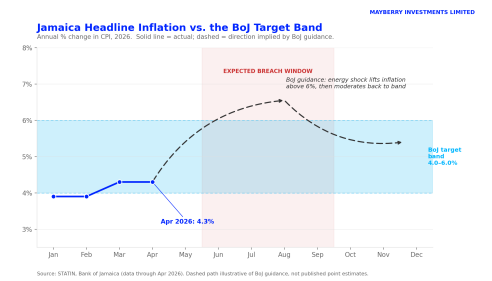
Solid line: actual headline inflation (STATIN), Jan–Apr 2026. Dashed path: direction implied by Bank of Jamaica guidance — illustrative, not published point estimates.
It is worth being concrete about how a distant war reaches a Jamaican balance sheet, because the channels are specific. We are among the most energy-dependent economies in the hemisphere — our oil trade deficit runs close to 7% of GDP, the largest such share in the region — so every sustained dollar on a barrel lands on electricity bills, transport, and the margins of any company that moves goods or runs a plant. At the same time tourism, our single largest earner of foreign exchange, is precisely the confidence-sensitive business a widening conflict threatens; the same easing in oil that cheers equity markets also, if it holds, steadies the visitor outlook on which a real slice of our growth depends. And because a portion of public and corporate debt is denominated in hard currency, the exchange rate is not a spectator to all this but a line item — which is why it matters that the central bank has sold roughly US$1.3 billion into the market over the past year to keep it orderly, and that, through all of this, the Jamaican dollar has actually firmed about half a percent against its U.S. counterpart. Stability of that kind is not luck; it is being bought, deliberately, with reserves and resolve — and bought for an economy the Bank estimates contracted by 1–2% in the fiscal year just ended, as Hurricane Melissa’s damage worked through. None of this argues for a dramatic response in a portfolio. It argues for the opposite — resilience over reach: pricing power that can absorb higher costs, income that compounds through the cycle, and the discipline not to mistake a calm tape for a settled world.
And so back to off stump. The hardest thing to do in a market at record highs, with a streak nine weeks long and a fear gauge asleep, is nothing — to leave the ball you do not have to play. But chasing a rally built on an unsigned ceasefire is how good capital is quietly given away. For the long-term investor, the disciplined strokes are the dull ones: rebalance after a run rather than into it, hold genuine diversification across assets and currencies, keep a bias to quality and liquidity, and preserve the ability to act when others are forced to. None of it requires a forecast. All of it requires patience — which, at the crease and in portfolios alike, is itself a position.
Have a good week, and leave the wide ones alone.