

Date: February 22, 2019
The Bureau of Labor Statistics (BLS) released their 2018 estimates surrounding occupational requirements in the United States. This survey consists of data across three samples over a three year period. The total sample included approximately 25,300 establishments and estimates represent about 140,800,000 civilian workers.
Education, training, and experience requirements
- For 2018, On-the-job training was required for 76.8 percent of all civilian workers with an average time period lasting 34 days.
- The preparation time required for an average worker to learn the on the job techniques, acquire the information, and develop the facility needed for average performance in a specific job can range between a short demonstrations to more than 10 years.
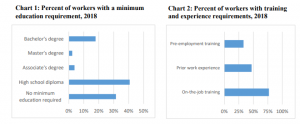
Requirements for all workers:
- Approximately 31.5 percent of workers had preparation time requirements that included more than a short demonstration and up to 1 month of preparation and 19.0 percent were required to have between 2 years and 4 years of preparation time.
- High school was the most common minimum education level for workers in 2018, with 40.7 percent of jobs requiring at least a high school diploma. There was no minimum education level required for 31.5 percent of jobs, while a bachelor’s degree was required for 17.9 percent of workers.
- On-the-job training was required for 76.8 percent of all civilian workers in 2018. Prior work experience was required for 47.0 percent of workers and 33.0 percent of workers were required to have completed pre-employment training.
Requirements by occupation:
- Prior work experience was required for 84.3 percent of accountants, with another 68.3 percent requiring on-the-job training. The majority (92.0 percent) of accountants required a bachelor’s degree.
- For management occupations, the most common (59.5 percent) minimum education level required was a bachelor’s degree.
- The majority of workers in food preparation and serving related occupations (81.4 percent) did not have a minimum education level requirement. A high school diploma was required for 18.1 percent of workers
- Over half (55.3 percent) of workers in production occupations were required to have a high school diploma. Post-employment training was required for 86.6 percent of these workers.
Environmental conditions
A variety of jobs across all industries contain concrete hazards or difficulties that are in the vicinity of where tasks are performed.
Requirements for all workers:
- About one-third (33.3 percent) of workers were required to perform outdoor work.
- Most workers were not exposed to humidity (98.9 percent), heavy vibrations (97.2 percent), extreme heat (94.8 percent), extreme cold (94.2 percent), hazardous contaminants (91.4 percent), or high, exposed places (89.8 percent).
Requirements by occupation:
- The majority of workers (92.3 percent) in construction and extraction occupations were exposed to the outdoors, while 76.1 percent worked in high, exposed places.
- Most recreation workers (74.3 percent) were exposed to the outdoors and 54.4 percent were exposed to wetness. Wetness is defined as any contact with waters or other liquids or working in a wet area.
- About half (53.0 percent) of welders were exposed to extreme heat, while 65.6 percent were exposed to moving mechanical parts.
Analyst Certification -The views expressed in this research report accurately reflect the personal views of Mayberry Investments Limited Research Department about those issuer (s) or securities as at the date of this report. Each research analyst (s) also certify that no part of their compensation was, is, or will be, directly or indirectly, related to the specific recommendation (s) or view (s) expressed by that research analyst in this research report.
Company Disclosure -The information contained herein has been obtained from sources believed to be reliable, however its accuracy and completeness cannot be guaranteed. You are hereby notified that any disclosure, copying, distribution or taking any action in reliance on the contents of this information is strictly prohibited and may be unlawful. Mayberry may effect transactions or have positions in securities mentioned herein. In addition, employees of Mayberry may have positions and effect transactions in the securities mentioned herein.